Culture and Regional Identity
Italy only became a unified nation in 1861, and in many ways it still hasn’t entirely finished becoming one. Regional identity runs deeper here than almost anywhere else in Europe, and it shows in everything from dialect to cuisine to architecture. A Milanese and a Sicilian might both call themselves Italian without agreeing on much else, from how a proper risotto should be made to which football club deserves loyalty. This regionalism isn’t fragmentation so much as richness, a country made up of what were once separate kingdoms, republics and city states, each of which left behind its own distinct cultural fingerprint.
Food is where this shows up most vividly. Piedmont’s cuisine, built around truffles, hazelnuts and Barolo, has almost nothing in common with Puglia’s, which runs on olive oil, orecchiette and fresh seafood, or Sicily’s, which carries centuries of Arab and Norman influence in dishes like couscous and arancini. Even coffee culture varies by region, and asking for the wrong thing at the wrong time of day in the wrong part of the country will earn you a certain look. Family remains the organising principle of daily life almost everywhere, Sunday lunch still treated with something close to reverence, and an unhurried relationship with time that visitors from busier cultures often find both maddening and eventually rather wonderful.
Art and architecture carry a weight here that’s hard to overstate. This is a country where a Roman aqueduct, a medieval church and a Renaissance palazzo can sit on the same street, still very much in use rather than roped off as museum pieces. Florence alone holds more Renaissance masterpieces than most countries hold in total, while Rome layers its history so thickly that construction projects routinely uncover ancient ruins nobody knew were there.
Landscape and Environment
Italy’s geography is extraordinarily varied for its size. The Alps run along the northern border, giving way to the dramatic pink limestone spires of the Dolomites in the northeast, a UNESCO World Heritage landscape that glows a deep rose colour at sunset, a phenomenon locals call enrosadira. South of the mountains, the Po Valley stretches out as Italy’s agricultural heartland, while further south still the Apennines run down the country’s spine like a second, gentler mountain range, thickly forested and home to wolf, brown bear and golden eagle populations that have rebounded significantly in recent decades.
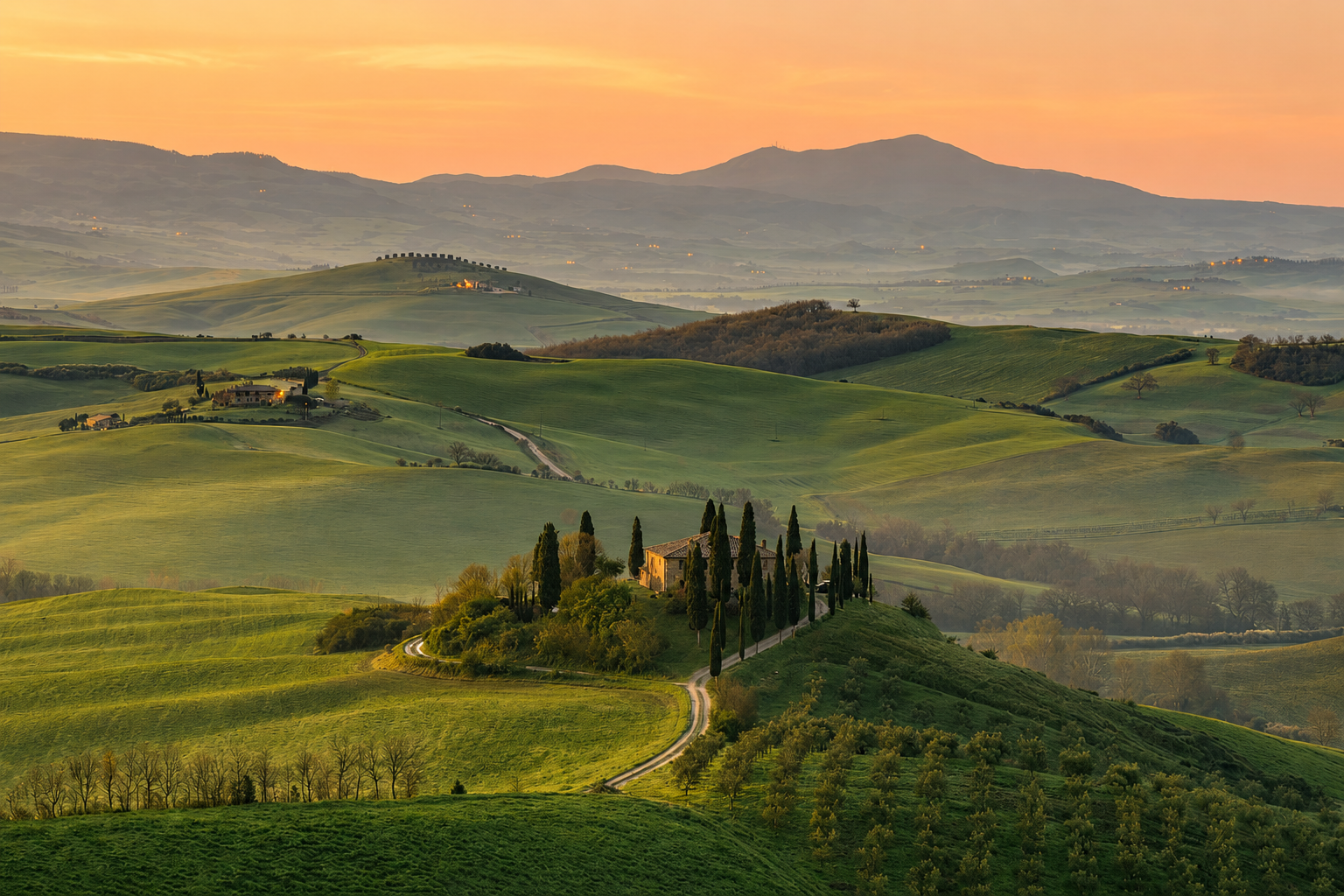
Tuscany and Umbria offer the classic rolling hill landscape most people picture when they think of rural Italy, cypress lined roads, vineyards and hilltop towns that have barely changed in centuries. Puglia, in the deep south, trades hills for flatter, sun bleached terrain covered in ancient olive groves, some of the trees estimated at well over a thousand years old, and the distinctive conical trulli houses that appear almost nowhere else on Earth. The Amalfi Coast delivers exactly the dramatic cliffside beauty its reputation promises, even if the narrow coastal road struggles under the weight of its own popularity in high summer.
Then there are the islands. Sicily carries an entirely different climate and culture, more North African and Greek in feel than mainland Italy, with Mount Etna, one of the most active volcanoes in the world, dominating its eastern half. Sardinia offers wilder, less developed coastline, granite mountains in the interior, and some of the clearest water in the Mediterranean.
Wildlife and Nature
Italy’s wildlife recovery over the past few decades counts among Europe’s quieter conservation successes. Wolves, driven to near extinction in Italy by the 1970s with barely a hundred individuals left, have rebounded to well over three thousand today, spreading back into the Alps and Apennines and even, occasionally, into areas close to major cities. The Marsican brown bear, a genetically distinct subspecies found only in the Abruzzo region, remains critically endangered but is the focus of dedicated protection efforts in Abruzzo National Park, one of Italy’s oldest and most important protected areas.
The Gran Paradiso, Italy’s first national park, has become a genuine ibex conservation success story, the species having been brought back from the edge of extinction in the early twentieth century when the park’s entire population numbered only a few dozen animals. Golden eagles, once seriously threatened, now nest across much of the Alps and Apennines, and marine life along Sardinia’s and Sicily’s coasts, particularly around protected areas like the Egadi Islands, includes dolphin pods and, in deeper Mediterranean waters, even occasional sightings of fin whales.
Regenerative Tourism in Italy
Venice remains Italy’s most visible test case for what happens when a place becomes almost too beloved for its own good. The city has introduced an entry fee for day trippers and capped the size and number of cruise ships allowed into its lagoon, both direct responses to a tourism model that was, quite literally, causing the city’s foundations and ecosystem measurable harm. It’s an imperfect solution and a contested one locally, but it represents a rare instance of a major destination genuinely limiting its own visitor numbers rather than simply chasing growth.
The agriturismo movement, meanwhile, has quietly become one of Italy’s most effective regenerative tools. Thousands of working farms across the country now host guests directly, channelling tourism income straight into small scale, often organic agriculture and helping keep traditional farming practices and rural communities alive in regions that had been steadily losing population to the cities for decades. Puglia and Basilicata have invested seriously in restoring ancient olive groves and dry stone wall landscapes, both under threat in recent years from disease and neglect, while national parks like Cilento and the Gran Paradiso continue active rewilding work for species that were nearly lost within living memory.
Italy has also pushed hard on renewable energy and sustainable wine and olive production, with a growing number of vineyards across Tuscany, Piedmont and Sicily converting to organic and biodynamic methods that restore soil health rather than depleting it. Coastal regions have expanded marine protected areas around Sardinia and the Tuscan archipelago, addressing decades of overfishing with measurable improvements in fish populations within these zones.
What ties all of this together, the wolves returning to the Apennines, the ibex recovering in Gran Paradiso, Venice finally setting limits on its own popularity, the small farms welcoming guests instead of losing their children to Milan or Turin, is a country slowly working out how to hold onto everything that makes it extraordinary without loving it to death in the process. Italy has never lacked for beauty or depth. What it’s learning now, town by town and region by region, is restraint.