
"Regenerative" has become tourism's favourite buzzword, yet the field still can't agree on what it means. We asked leading voices what regeneration actually requires, and looked at four African lodges proving it on the ground, from reforested tea estates to a 50-year rewilding pledge.
Laetitia Hörnler
The word ‘regenerative’ has a buzz about it – tied to travel and tourism and increasingly being dropped at conferences, discussion panels and on marketing decks. Yet it’s true definition is up for debate. Here, we join the conversation with some experts who are exploring the term, its distinction from sustainability and how the industry is living up to it.
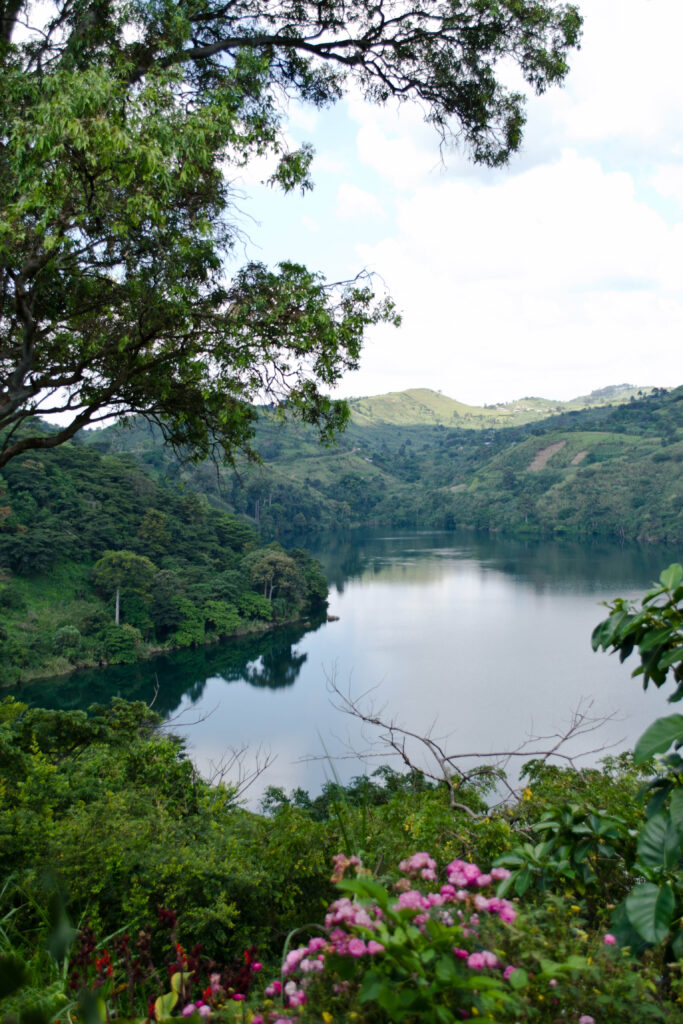
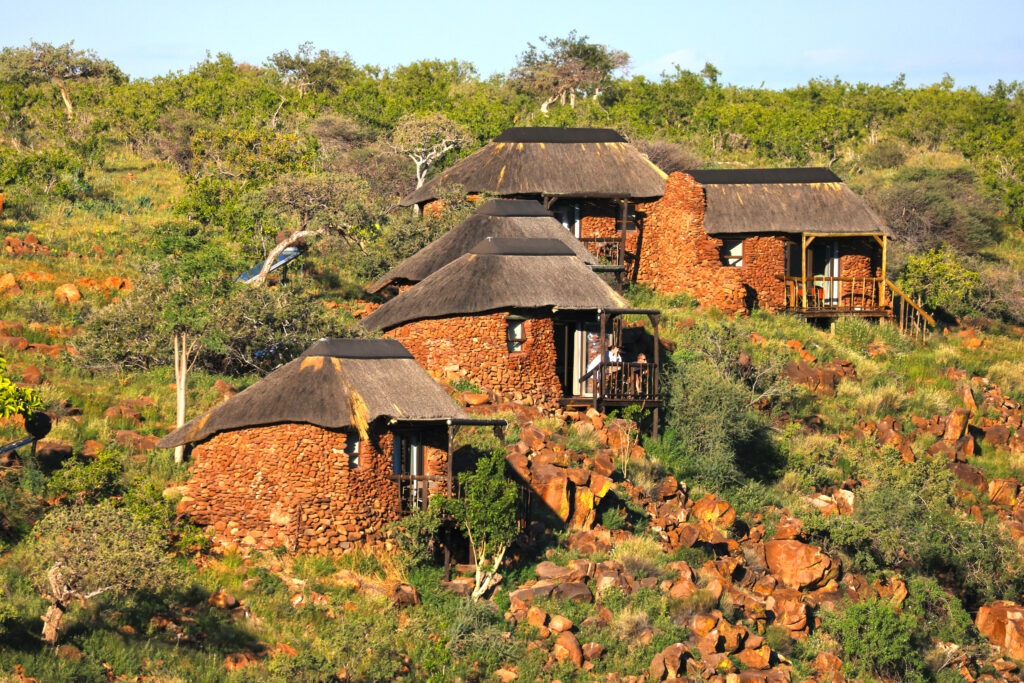
Four places are making the case for regeneration in real life. On a former tea estate in Uganda, Ndali Lodge spent sixteen years reforesting land back into habitat which wildlife returned to on its own terms. In Namibia’s Damaraland, Grootberg Lodge achieved the same with former farmland, restoring it until the emptiness of the landscape stopped being absent and started being repaired. In Kenya’s Chyulu Hills, Campi ya Kanzi exists as the tourism arm of a conservation trust, not the other way round, funding a wildlife corridor by making coexistence pay for itself. In South Africa’s Soutpansberg, Few & Far Luvhondo has committed to a fifty-year rewilding programme.
These properties don’t call themselves ‘regenerative’ because of optics. Each is a different answer to the same question we’re keen to explore: not what the word means but what it requires.
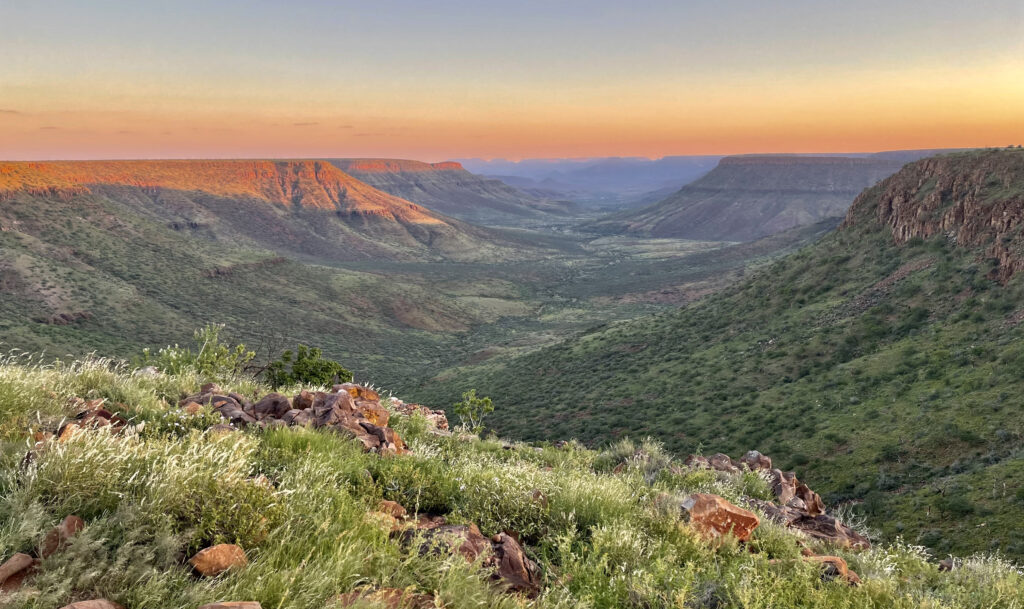
Standing on the escarpment above Grootberg Lodge, looking out over Damaraland’s Klip River valley, two things are immediately striking: the scale of the land and the absence of people. That space isn’t natural; it’s recent. This was farmland before it was wilderness again. Grootberg was regenerated back into habitat. Similarly, Ndali Lodge, in Uganda, achieved the same with a former tea estate, reforesting it until wildlife returned on its own terms.
Regenerative tourism tends to be strongest in places like this, landscapes where nature was never scenery but the whole reason anyone came. Which raises an obvious question: if wildlife is the point, why did it ever need saving from the industry meant to protect it?
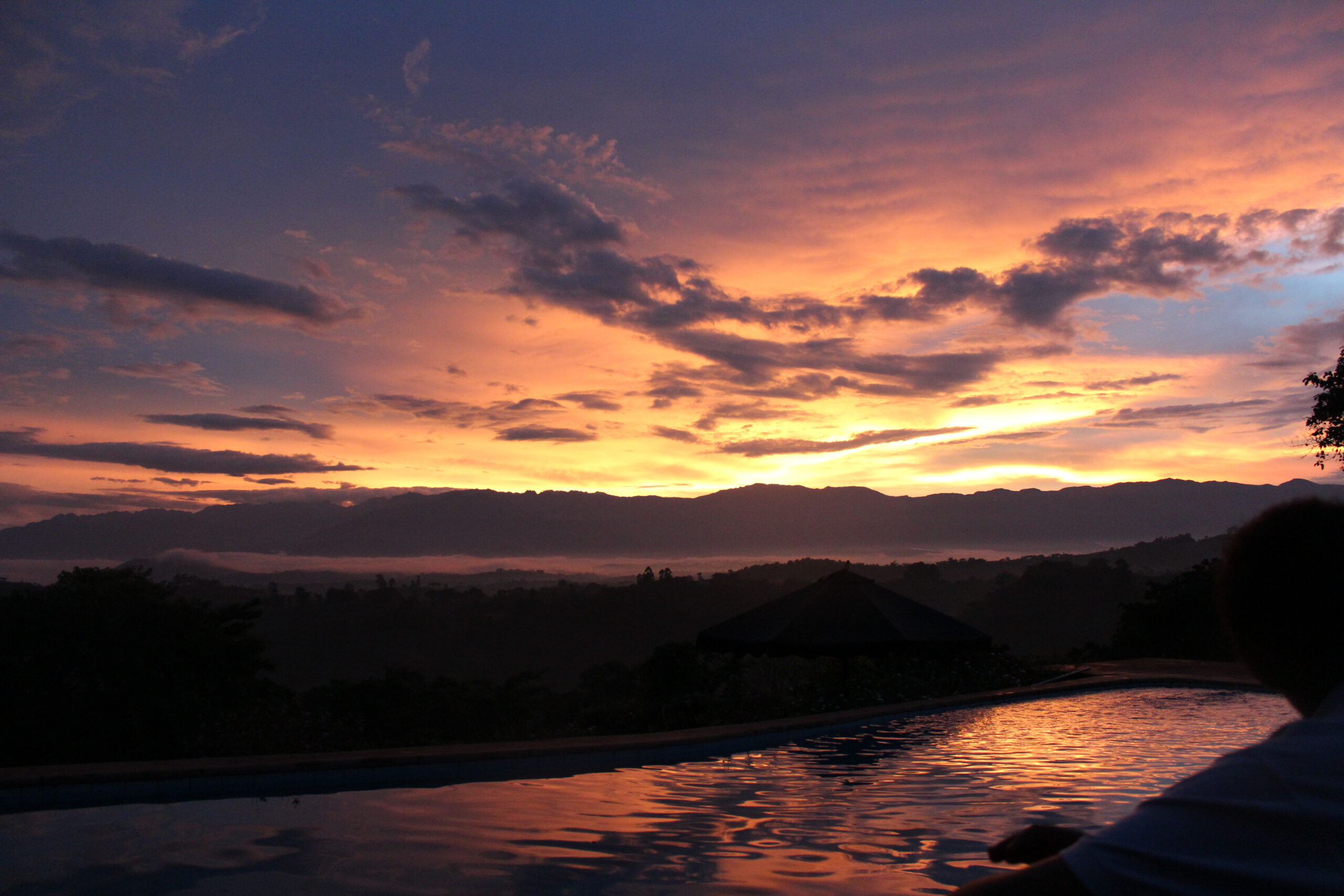
The core distinction
Sustainable tourism, honestly defined, is a subtraction problem: how do we take less water, less land, and less disruption from a place. Regenerative tourism asks a different question entirely, one closer to what it would take to leave a place better than tourism found it. This isn’t sustainability with the dial turned up. The premise underneath it is genuinely different.
Alessandro Inversini, who has spent years building the academic framework behind much of this thinking, put it more precisely than I can: “What if sustainability is the foundation not the destination? I don’t see regeneration as a replacement for sustainability, I see it as its natural consequence: a personal journey to discover how living systems, and even the people within them, are interconnected.”¹
That interconnection is easier to see in places where it was never lost. Long before “regenerative tourism” had a name, much of Damaraland and Fort Portal operated on something close to its principles, not by design but by necessity. Circular use of water, waste and energy wasn’t a sustainability strategy. It was what survival required in places too remote for any other kind of infrastructure. The West is, on the whole, slow to relearn an interconnectedness that other parts of the world never fully set aside but quick to name it once it notices. “Regenerative tourism” is, in part, a Western name for a much older relationship with land.
That relationship wasn’t always a peaceful one and it’s worth resisting the temptation to romanticise it. Across much of Africa, land now framed as pristine wilderness was, within living memory, contested ground, between subsistence and survival, and between people and the predators competing for the same terrain. Conservation wasn’t always the priority it is today. Farming, for a long stretch, offered a steadier living than coexistence with wildlife did, and habitat shrank accordingly. Grootberg and Ndali aren’t stories of land preserved. They’re stories of land taken back; farmland deliberately returned to habitat after having been given over to something else. That reversal is closer to what “regenerative” means than anything achieved by simply doing less harm to land that was never disturbed in the first place.
Where the field disagrees
Willy Legrand draws the line cleanest. “Place first, tourism second,” he says. “Regeneration asks what a place needs to thrive on its own terms and only then whether tourism has any business being part of that answer. Sustainable tourism takes tourism as given and asks how to manage the impacts. Responsible tourism takes the traveller as given and asks how they should act. Regenerative tourism refuses both because regeneration does not promise that tourism will work out.”²
That’s a tidy formulation. Not everyone in the field would sign off on it quite so cleanly.
Anna Pollock has spent decades arguing that sustainability, however well-intentioned, isn’t enough: its practices address symptoms rather than causes and can quietly convince an industry it’s allowed to carry on as before. ³ For Pollock, regeneration isn’t a further step along the same road as sustainability. It’s a different road, built on the premise that humans are part of nature rather than separate from it, tending it rather than extracting from it. ⁴
Bill Reed, whose work at Regenesis shaped much of the regenerative-development thinking tourism has since borrowed, goes further still, dismissing the idea that this is primarily a technique at all. “Your project is not the project. The project is life,” he says. ⁵ The real work, in his view, isn’t a set of sustainability metrics to hit but building the capacity of the people in a place to sustain it long after the project or the guests have moved on.
Others hold the definition more loosely. Sonia Teruel, who has spent years working with community-based tour operators in transition, describes regeneration less as a fixed standard than a direction of travel, one that inevitably puts projects in tension with an industry still built to reward speed and volume, whatever language it borrows to describe itself. ⁶
Slogan central to the problem
A 2023 academic review makes a more uncomfortable argument still, that the field’s easy slogans like “leaving a place better than it was found” and „net positive,” are themselves part of the problem, flattening a paradigm shift into something that can be checked off a list.⁷ Its authors concede something rarely admitted so plainly in scholarship: as Western, English-speaking academics, they aren’t positioned to represent the Indigenous and non-Western ways of knowing that shaped this relationship to land and place long before “regenerative tourism” existed as a term at all.⁷
Tina O’Dwyer, founder of The Tourism Space, spent a summer quietly asking herself whether she still believed in the term at all. Watching momentum stall and language get borrowed for marketing, she went back to first principles rather than definitions and found she believed in the underlying commitments place as a living system, success measured as flourishing rather than harm avoided – more strongly than ever. What she’d lost interest in was the label itself. “I was never interested in defending a definition,” she writes. ⁸
Susanne Etti, general manager for climate at Intrepid Travel, focuses less on what regeneration means and more on who gets to decide it in practice. “Regenerative travel needs to be led by local and Indigenous communities to define what a healthy future for their home looks like, how tourism can contribute to this and how success is assessed,” she says. ⁹ It’s a governance test rather than a definitional one and, by that measure, a great deal of what currently calls itself regenerative would fail before the ecological question is even asked.
That’s a genuinely different kind of disagreement than the others here – less about where the line sits than about whether policing the line is worth the field’s energy at all.
Taken together: Legrand’s place-first framing, Pollock’s ecological standard, Reed’s rejection of technique altogether, Teruel’s directional commitment, O’Dwyer’s turn from the label toward the principle beneath it, Etti’s insistence on who leads rather than what’s claimed, and the field’s own challenge to its authority to define itself amount to genuinely different claims about what regeneration requires, and who, if anyone, gets to hold the definition.
The proof in practice
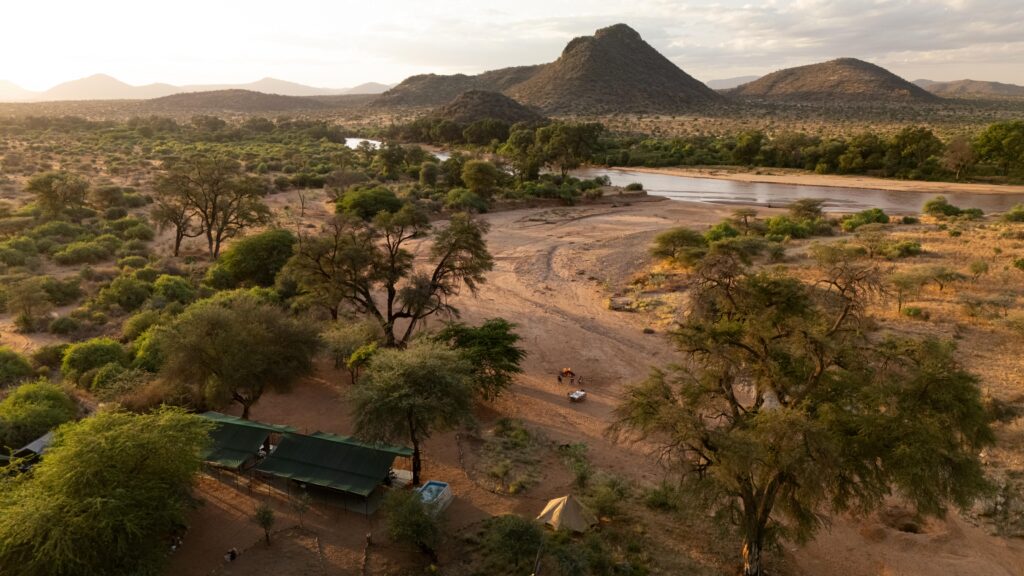
Campi ya Kanzi, in Kenya’s Chyulu Hills, makes its case through the economics of coexistence. The lodge sits on 283,000 acres of Maasai-owned Kuku Group Ranch land and exists as the tourism arm of a conservation trust rather than the other way around: profits fund the trust, not the reverse. Every guest pays a nightly conservation fee, the bulk of which compensates Maasai herders directly for livestock lost to the lions and leopards the lodge exists to protect, turning a cost pastoralist once bore silently into one the tourism economy now explicitly absorbs. Around 70people from the local community work at the lodge, and nearly 190 more are employed as rangers across the wider conservancy. This isn’t incidental. It’s the mechanism by which a wildlife corridor connecting four separate ecosystems stays open at all, because the people who hold the land have an economic reason to keep it that way.
Few & Far Luvhondo, tucked into South Africa’s Soutpansberg mountains, makes the same argument on a longer clock. Co-founder Sarah Dusek, who built and sold the glamping company Under Canvas before turning to something slower, has committed the lodge to a 50-year rewilding programme across tens of thousands of hectares of degraded land, funding invasive-species clearance and grassland regeneration through every stay. The lodge runs carbon-negative, and much of what it’s built with- heat-treated eucalyptus, processed on-site -comes from the land it’s trying to heal rather than shipped in from elsewhere. A 50-year horizon isn’t, by its nature, a marketing claim. Nobody measures a quarterly report against it.
Different geographies, different scales of ambition. Neither property treats regeneration as a feature bolted onto the business. Both have restructured what the business is around it.
The verification issue
None of this, from Ndali’s 16 years of reforestation to Campi ya Kanzi’s conservation fee and Few & Far’s 50-year pledge, means anything if there’s no way to check it. That has always been true. What’s changed is who’s doing the checking.
Increasingly, it’s an AI system summarising a destination, recommending a lodge, weighing one claim against another across thousands of properties in seconds, and a system like that is only as good as what it’s fed. Self-reported claims, the kind that fill most sustainability pages today, are easy for a model to repeat and impossible for it to verify. Trained on marketing language, it hands marketing language back to the traveller, dressed up as a recommendation.
Regulation is closing the same gap from the other direction. From 27 September 2026, the EU’s Empowering Consumers Directive requires environmental and social claims made to consumers to be substantiated, not merely asserted. For hospitality, this marks a shift Forbes recently described as the industry entering “an era of impact reporting”, where evidencing impact is becoming a competitive necessity rather than a goodwill gesture. ¹⁰ What was optional is becoming structural.
Independent verification exists to answer exactly this gap, checking a property’s claims against evidence the way a financial audit checks a balance sheet rather than trusting a company’s own account of it. Veriva does this for regenerative tourism specifically: sample-verifying claims through an independent third party, rather than certifying properties or selling them a badge.
It remains a small corner of a vast industry. If even a modest fraction of that industry shifted from doing less harm to actively leaving places better, the effect on the ground, in the Chyulu Hills, in the Soutpansberg, would be far from modest.
The Veriva Verdict
All this exists to help people like me, coming to this from the
outside, understand something that was never actually missing a definition. It was missing our attention. Long before anyone reached for the word “regenerative” in a conference hall, communities across the world were living in reciprocal relationship with the land that fed them, because they had no other choice, and no other worldview. That knowledge doesn’t need translating into a framework to be valid. It was never waiting for us to name it.
Frameworks matter anyway, but only as scaffolding, a way for an industry fluent in growth targets and occupancy rates to begin grasping something it has spent a century treating as a footnote. The scaffolding is not the building.
There’s a harsher truth here. None of these scales on good intentions alone. If regenerative tourism stays a boutique pursuit for a handful of exceptional, mission-led properties, it will remain exactly what its critics fear: a beautiful idea that changed almost nothing. For it to matter, it must reach the thousands of sustainability-minded hotels currently doing their careful, incremental best, and give them a genuine, economically sane path toward doing more. That transition will be messy and partial, and some of it will fail. An ideal is allowed to be pure. A shift inside an 11,6 trillion-dollar industry doesn’t have that luxury and doesn’t need it to still be worth everything it could deliver.
That is what’s at stake, once the terminology fights fall away. A Maasai family no longer bearing alone the cost of the lion that took their livestock. A child in Fort Portal in school because a forest was allowed to regrow rather than extracted a second time. A species with a little more time, an ecosystem with a little more resilience against a climate already moving faster than any of us would like. Travel and tourism generated $11.6 trillion last year, nearly a tenth of the entire global economy. ¹¹ Even a sliver of that, redirected from merely sustaining what remains toward actively rebuilding what’s already been lost, would be one of the largest transfers of capital toward planetary and human repair available to us this decade. This is not hypothetically – that money is already moving.
This isn’t a definition, and it was never meant to be one. It’s a bet that an industry built on people’s appetite to see the world might, if enough of us insist on it, help leave a little more of that world standing.
Footnotes
- Alessandro Inversini, LinkedIn post, September 2026. https://www.linkedin.com/feed/update/urn:li:activity:7506608653836374016
- Willy Legrand, IU International Hochschule. [Interview/correspondence with the author, confirm date and context before publication.]
- Anna Pollock, “The Promise of a Regenerative Tourism,” keynote, European Travel Commission Workshop, Krakow, 6 February 2019. https://etc-corporate.org/uploads/2019/02/06022019_Anna_Pollock_ETCKrakow_Keynote.pdf
- Anna Pollock, “Flourishing Beyond Sustainability: The Promise of a Regenerative Tourism,” transcript, SlideShare, 2019. https://www.slideshare.net/slideshow/flourishing-beyond-sustainability-docx/253128101
- Bill Reed, quoted in Ernesto van Peborgh, “Learning to See: Walking the Path of Regeneration with Bill Reed,” Medium, 2025. https://ernesto-87727.medium.com/learning-to-see-walking-the-path-of-regeneration-with-bill-reed-142ddd3d85dc
- Sonia Teruel, “Is regenerative tourism elitist?”, The RegenLab for Travel, Substack, 2026. https://steruel.substack.com/p/is-regenerative-tourism-elitist
- Loretta Bellato and Anna Pollock, “Regenerative tourism: a state-of-the-art review,” Tourism Geographies, published online 19 December 2023. https://www.tandfonline.com/doi/full/10.1080/14616688.2023.2294366
- Tina O’Dwyer, “Is Regenerative Tourism Something to Believe In?”, 2026. https://www.tinaodwyer.com/blog/is-regenerative-tourism-something-to-believe-in%3F