
A methodology that reads the place before it reads the practice.
The Veriva Compass is an independent assessment that turns a property’s impact on its place into structured, machine-readable, evidenced data. It is not a certification, a seal or a label. Every data point shows where it came from and how it was checked. This page explains how the assessment works, what the data can and cannot be used for and how we verify it.
The Core Differentiator
Not a badge.
A journey.
Veriva does not award a pass/fail badge. Each Compass profile shows where a property stands today in each dimension of its impact and how that changes over time.
A property at Aware stage is not failing. Its profile shows what is already in place and what the next steps look like. A property at Regenerative stage has a documented record of how it got there. Both profiles are useful because both are specific and backed up with data.
Binary badge certified or not certified. No indication of where a property is on its journey or what it is working towards.
A single score or percentage that collapses four dimensions into a meaningless number or badge.
A published position on a five-stage journey. Honest, evolving and specific to each dimension, sample verified.
A time trajectory that shows the development of a property over time.
Journey to Regeneration: how every Compass profile is shown
- Aware Recognising the responsibility to act
- Foundation Basic responsible practices in place
- Active Intentional, evidenced, consistent practice
- Regenerative Actively improving the living system
- Exemplary Sector-defining leadership practice
This example shows a property currently at Active stage — having passed through Aware and Foundation. The profile shows what evidence supports this position and what the path toward Regenerative looks like for this specific property in its specific context.
The journey never ends and 100% is not the goal. Regeneration is not a destination. It is an ongoing relationship between a property and the living systems it inhabits. The timeline always continues beyond what is shown. Exemplary today does not mean complete. It means leading and still moving.
The Core Differentiator
A tool that works for you.
Not an inspection of you.
The Veriva Compass is designed as a business asset for properties doing genuine regenerative work. Here is what every assessed property receives and why it matters.
Your Compass Star
A visual profile of your unique strengths
Every property receives a four-axis radar chart showing its position across all four Compass Dimensions. No two properties look the same. A community-owned lodge and a regenerative farm have completely different stars and both are valuable. The star shows where you are genuinely strong, not just where you meet a minimum threshold, it is for internal use only.
Your Journey Position
An honest picture of where you stand and where you are going
Your overall position on the regenerative journey is shown on a five-stage timeline: Aware, Foundation, Active, Regenerative, Exemplary. This is not a pass/fail. It is an honest map of your progress and a story you can tell your guests with credibility, because it is independently verified.
Structured, machine readable Data Profile
Creating a trust layer for the AI that plans travel in the future.
JSON-LD output compatible with the Travalyst Data Hub, making the property’s evidenced practices searchable and checkable by booking platforms (e.g. Booking.com, Expedia, Airbnb) — this is infrastructure/data portability, a factual capability claim, not a marketing claim about the property itself.
Your EmpCo Compliance
Independent sample verification before it becomes mandatory
Every assessment is sample-verified by Dreame & Charme. This is the part that actually does EmpCo-relevant work: it’s what lets the property say its Compass data is independently checked as long as the property’s own claims stay scoped to what was actually sampled, not “100% verified.”
One important thing to understand:
Veriva does not expect any property to be strong across all four dimensions. No property in the world is. What matters is that you are honest about where you are and committed to the direction of travel. The Compass is designed to show your genuine strengths, name your honest gaps, and help the right travellers find you.
The Compass Star — Visual Example for internal use
No two properties have the same star.
The star shows a property’s unique profile across all four dimensions at a glance. A community lodge and a regenerative farm look completely different. Both are valid. Both are valuable. The shape of the star tells the story.
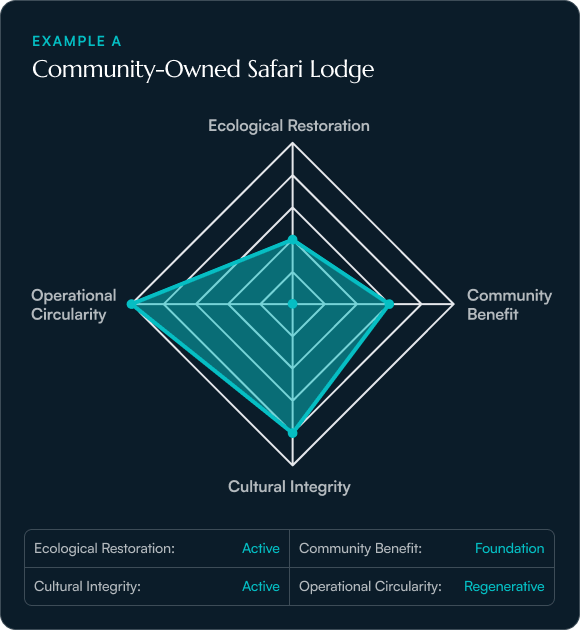
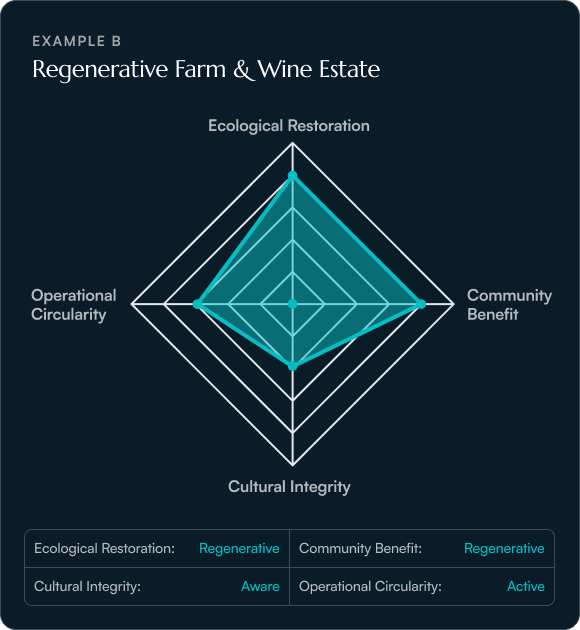
Both profiles are honest. Both are valuable. The community lodge is leading in Community Benefit that is its story. The farm is leading in Ecological Restoration and Operational Circularity that is its story. Veriva does not expect any property to be strong in all four dimensions. No property in the world is. The star shows where you genuinely stand and that is always enough to start.
The Methodological Foundation
Where the standard comes from?
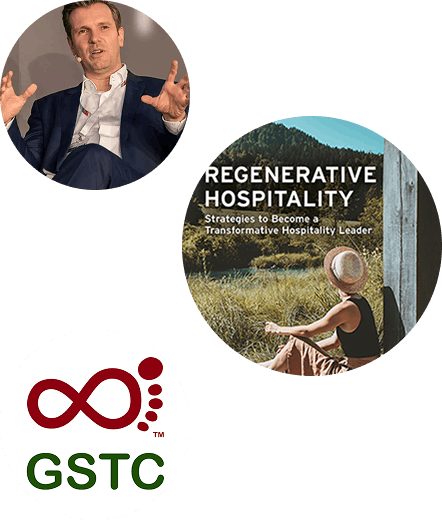
The standard integrates Alessandro Inversini’s Regenerative Hospitality Canvas, published by the Ecole Hôtelière de Lausanne (EHL) in 2025 the most rigorous academic framework currently available for understanding regenerative practice in hospitality. From Inversini’s Canvas, Veriva draws three core elements: the Spirit of the Place criterion, the People Intelligence dimension, and the Observe–Reflect–Act structure that underpins the two-stage assessment process.
The Veriva Compass standard was developed with feedback from Alessandro Inversini and Professor Willy Legrand, Professor of Sustainable Hospitality Management and one of Europe’s leading authorities on sustainability assessment in the hospitality sector. The standard draws on his principles of honest diagnosis, non-reductive assessment, and what he describes as the mirror-not-filter approach: the assessor’s role is to reflect what is genuinely present, not to filter out inconvenient evidence.
Veriva is a GSTC Organisation Member. The standard is designed from its foundation to be auditable by a GSTC-accredited independent certification body. The data will be sample verified by a GSTC certification body.
Verification
Independently checked, and clear about what was checked.
Random selection.
A random sample verification for every property
An AI tool selects one claim from the property’s profile at random. Properties cannot predict which claim it will be, so every answer needs to be accurate.
Independent check.
To ensure high data quality it is sample verified
An independent third-party (GSTC accredited certification body) is our verification partner and checks that claim against the evidence (data provided by the property).
Renewal every three years.
Renewal ensures data is up to date
In order to ensure the data is always up to date, the questionnaire will be updated every 3 years and that data will also be sample verified by our third party partner.
What this means
An incentive for every claim to be true
Each profile states which claim was independently verified and when. Everything else in the profile is property-reported data, reviewed by a Veriva assessor, and labelled as such. The verification is meant to incentify everyone to remain truthful.
The Four Compass Dimensions
What we assess
Place context comes first
A coastal lodge in a water-scarce region, a community farm in a post-conflict area, an alpine retreat in an over-touristed valley, each faces fundamentally different challenges. The Veriva questionnaire captures the specific ecological, social, and cultural tensions of each place before assessing practice. The same dimension, at the same level, means something different depending on what the place actually needs.
Each property is assessed in four dimensions. Each dimension is assessed separately. There is no average and no overall score.
Dimension 1
Ecological Restoration
The hotel's active contribution to the health of the ecosystems it inhabits beyond avoiding harm.
Ecological Restoration distinguishes between conservation protecting what exists and restoration actively improving what has been degraded. A property that plants native species, restores degraded habitat, or contributes to landscape-scale conservation efforts demonstrates active ecological restoration.
Dimension 2
Community Benefit
The genuine economic and social benefit to the local community including community agency over decisions that affect their lives.
Community Benefit asks not just whether local people benefit from the hotel’s presence, but whether they have genuine agency over decisions that affect them. Employment and wages matter. So does whether the community has any formal role in decisions about shared resources.
Dimension 3
Cultural Integrity
The hotel's relationship to the cultural heritage and living identity of the place it inhabits.
Cultural Integrity asks who holds the pen on how local culture is represented. The critical distinction is authorship: whether local culture practitioners are genuine co-authors of how their culture is presented to guests, or whether they perform a version curated by the hotel for commercial purposes.
Dimension 4
Operational Circularity
How energy, water, food, and waste flow through the hotel's operations and the direction of travel.
Operational Circularity assesses whether the hotel’s resource systems move toward closed loops renewable energy, water recycling, local food sourcing, waste reduction. The direction of travel matters as much as the current position.
The Assessment Levels
How levels work
Stages describe practice. They are not scores. Each dimension shows its own stage, the evidence behind it and any significant gaps.
Aware
No practice exists in this dimension. The hotel has not yet engaged with this area of responsibility. Published honestly, the profile explains what is absent and why.
Foundation
Basic practice is in place. The hotel is avoiding the most obvious harms but is not yet actively improving conditions. Published with context, the profile notes what exists and the trajectory toward higher practice.
Active
Practice is intentional, evidenced, and consistently applied. The hotel is managing its impact and has systems or relationships that demonstrate genuine commitment. Published as a positive finding.
Regenerative
Practice is actively improving conditions beyond the hotel’s operational boundary contributing to the health of the living system in ways that are evidenced and ongoing. Published as a leading practice finding.
Exemplary
Regenerative practice is embedded in how the property is owned, governed and run, and its impact reaches beyond its own boundaries. It shows measurable, long-term gains for land, community and culture, shares what it learns openly, and actively helps others such as neighbours, peers and its destination move forward. Exemplary is not a finish line. These properties are still learning and still moving.
The Fifth Criterion
Spirit of the Place
From

Alessandro Inversini
Regenerative Hospitality Canvas
EHL Lausanne 2025

Every place has an irreplaceable character, its rhythms, its memory, its particular way of being. Regenerative hospitality strengthens this spirit rather than diluting or commodifying it.
This criterion is assessed independently of the four dimensions and applies to the Compass profile as a whole. A property can meet all four dimension thresholds and still fail the Spirit of the Place criterion if its presence is assessed as materially diluting the character of the place it inhabits.
The assessor asks: is this hotel making this place more itself or more generic? Community members’ perspectives are weighted heavily in this assessment.
The Two-Stage Assessment Process
How the assessment works
1
The GM Place Mirror Questionnaire
The General Manager completes a detailed questionnaire alone, at a time that suits him/her. It captures hotel basics, ownership structure and critically reviews the specific challenges and tensions of the place itself: ecosystem type, water stress, primary local livelihoods, the social and ecological pressures unique to that location. The same question means something different depending on where a hotel sits and what its context demands. Then it evaluates how regenerative the hotel is based on the four dimensions: ecological restoration, cultural integrity, community benefit and operational circularity. Approximately 90 minutes. Every question needs to be backed up by data. The responses generate a structured, machine readable data profile that forms the foundation of the Compass assessment.
2
The Compass Call
A 90-minute independent assessment conversation between the Veriva assessor and the GM or property owner. The Call validates, deepens, and tests the questionnaire responses. The assessor asks about practice, evidence, tensions, and what the hotel does when no certification requires it and no guest is watching.
3
Independent Assessment & Verification
The assessor reviews all evidence and sets a stage for each dimension, plus the Spirit of the Place finding. One claim is then selected at random and verified by an independent third party (see How verification works).
4
Published Compass Profile
The property receives its full profile and its machine-readable data profile. Its public profile appears on Veriva, including gaps as well as strengths. Profiles are updated as practice develops every 3 years, so the timeline shows change over time.
The Pathway to Impact Reporting
From assessment to an Impact Report
Veriva Compass is an independent assessment rigorous, published, and academically grounded. Veriva will also launch a digital tool to create an impact report from the Compass assessment in 2027.
Veriva Compass
- Independent assessment
- Published criteria & non-compliance procedures
- Machine-readable JSON-LD data profile
- Travalyst Data Hub compatible
- Sample sport verification by GSTC accredited third party
Veriva Impact Report
- Full impact report ready for investor DD
- Digital tool that creates an impact report within minutes
- GSTC-accredited third-party sample verification
- Saves properties a lot of time and capacity
- Builds directly on Compass assessment
Editorial Independence
What Veriva will and will not do
Veriva will
- Publish Compass profiles that include honest assessments of gaps as well as strengths
- Publish when properties do not qualify for the Compass
- Update profiles when practice changes in either direction
- Name the evidence base for every published finding
- Maintain a public record of all non-compliance decisions
- Respond to complaints from community members about the accuracy of published profiles
Veriva will not
- Accept payment from hotels in exchange for a Compass profile
- Accept advertising or sponsored content from hospitality brands
- Allow hotels to amend assessment findings before publication
- Suppress a published profile at a hotel's request
- Assign a Compass assessed by someone with a material or personal relationship to that property
Methodology & Acknowledgements
Foundation of the Compass
The Veriva Compass standard draws on academic work and established sustainability standards. Each contributes a specific and irreplaceable element to the methodology.
Alessandro Inversini
EHL Lausanne · Regenerative Hospitality Canvas (2025)
Three elements draw directly from Inversini’s Regenerative Hospitality Canvas: the Spirit of the Place criterion, People Intelligence as an assessment layer alongside the four Compass dimensions and the Observe, Reflect, Act structure underpinning the two-stage assessment process.
Social Development Goals
UN Social Development Goals
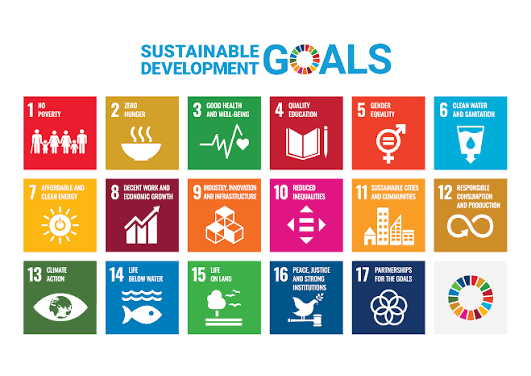
The UN’s 17 Sustainable Development Goals set the global standard for what responsible development looks like but for most hospitality businesses, “supporting the SDGs” stays a claim on a website rather than something anyone can actually verify. The Compass Assessment closes that gap.

GSTC
Global Sustainable Tourism Council · Organisation Member
Veriva is a GSTC Organisation Member. The Veriva Verified certification scheme (2027) is designed for alignment with GSTC criteria and ECGT requirements under EU Directive 2024/825. Veriva Verified will engage a GSTC-accredited independent audit partner for third-party verification.
Ready to apply for a Compass Assessment?
Read the full Criteria Document before applying. Every application is personally reviewed.
