
Destination
Morocco
Why Morocco?
Culture and Indigenous People
Morocco’s cultural identity rests heavily on its Amazigh, or Berber, heritage, the indigenous people of North Africa whose presence here predates Arab arrival by thousands of years. Roughly forty percent of Moroccans identify as Amazigh, and their language, Tamazight, was only recognised as an official language alongside Arabic in 2011, a milestone that came after decades of cultural advocacy. Amazigh identity remains especially strong in the Atlas Mountains and pre Saharan regions, where distinct dialects, textile traditions and music, characterised by the rhythmic ahwash dances and the haunting sound of the guembri, have been passed down largely outside the country’s urban centres.
Marrakech and Fez carry the more familiar version of Moroccan culture that most visitors encounter first, medinas built as labyrinths on purpose, centuries old souks organised by craft, from metalwork to leather to textiles, and a call to prayer that still structures the rhythm of daily life. Fez’s medina, one of the largest car free urban spaces in the world, still functions much as it did in the medieval period, tanneries, mosques and madrasas woven into a single dense, living neighbourhood rather than a museum piece.
Food culture runs deep and regional. Tagines vary considerably from the Atlas to the coast, mint tea is less a drink than a ritual of hospitality poured with real ceremony, and Friday couscous remains a near universal tradition across households regardless of region or class. Hospitality itself carries enormous weight in Moroccan culture, guests are treated with a warmth that visitors often describe as the most memorable part of the entire trip, more than any single sight.
Landscape, Environment and Wildlife
Morocco’s landscape shifts dramatically within remarkably short distances. The High Atlas mountains rise to over four thousand metres at Jebel Toubkal, North Africa’s highest peak, their lower slopes terraced by Berber farming communities who have cultivated these valleys for centuries using irrigation systems that predate modern engineering by a long way. Further south, the Anti Atlas and the edges of the Sahara take over entirely, the dunes around Merzouga and Zagora shifting through extraordinary colour changes as the sun moves across them, and nights out there delivering some of the darkest, clearest skies left anywhere near Europe.
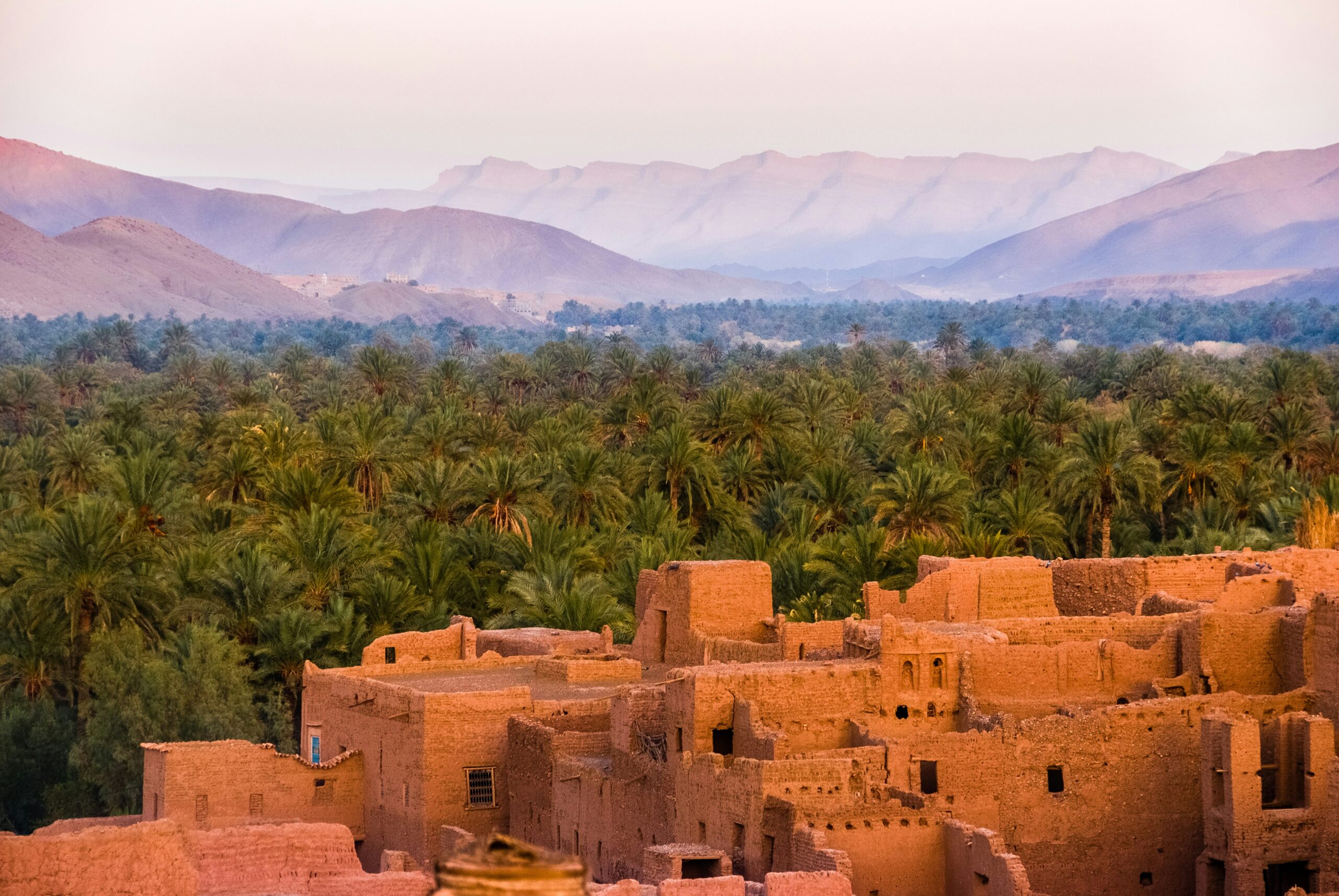
The coastline tells its own story. The Atlantic side, around Essaouira and further south toward Agadir, brings cooler air and strong winds that have made this stretch a serious draw for surfers and windsurfers, while the Mediterranean coast in the north carries a gentler climate and closer ties, historically and culturally, to southern Spain. Inland, the Ourika and Dades valleys offer some of the country’s most striking scenery, kasbahs built from rammed earth rising out of palm groves and rose fields that turn the Dades Valley into a genuine pilgrimage site each May when the Rose Festival marks harvest season.
Wildlife in Morocco is more understated than in the great safari destinations further south, but genuinely distinctive. The Atlas Mountains hold Barbary macaques, the only primate species found wild in Africa outside the sub Saharan region, along with Barbary sheep and a healthy population of raptors including golden eagles and lammergeiers. The pre Saharan zones support fennec fox, desert hedgehog and a surprising range of reptile life adapted to extreme heat, while the coastal wetlands, especially around Merja Zerga near Larache, are internationally significant stopover points for migratory birds moving between Europe and Africa, drawing serious birders for flamingo, spoonbill and osprey sightings each year.
What Morocco Is Doing in Regenerative Tourism
Morocco’s most visible regenerative achievement sits just outside Ouarzazate, where the Noor complex has become one of the largest concentrated solar power facilities on Earth, part of a national strategy aiming to generate a majority of the country’s electricity from renewable sources within the coming years. It’s an enormous infrastructure commitment, and it signals something important about the direction the country as a whole is moving in, treating clean energy not as a side project but as central economic strategy.
At a smaller and arguably more human scale, argan oil cooperatives across the southwest have become one of the clearest examples anywhere of tourism and conservation reinforcing each other. Argan trees, found wild nowhere else on the planet, are harvested by women’s cooperatives using traditional methods that both preserve ancient trees, some centuries old, and provide meaningful income in rural areas where alternatives are scarce. UNESCO designated the argan forest a Biosphere Reserve specifically because of how closely conservation and community livelihood are intertwined there, and a growing number of these cooperatives now welcome visitors directly, turning what was once a purely commercial supply chain into a genuine cultural exchange.
In the High Atlas, community run guesthouses and trekking cooperatives, many built around the villages surrounding Toubkal and the Ourika Valley, channel a significant share of tourism income directly into Berber communities that would otherwise depend almost entirely on subsistence agriculture, an increasingly precarious livelihood as rainfall patterns shift with the changing climate. These initiatives tend to be small, mule based trekking, home cooked meals, guides drawn from the villages themselves, but their cumulative effect on rural income and cultural preservation has been considerable.
Water remains Morocco’s central environmental challenge, and the country has responded with real investment in desalination and drip irrigation programmes, alongside a broader push to protect the traditional khettara irrigation systems in oasis regions like the Draa Valley, ancient underground channels that have sustained desert agriculture for a thousand years and are now being restored rather than abandoned as groundwater levels drop.
What runs through all of this, the solar plants, the argan cooperatives, the mountain guesthouses, the restored oases, is a country trying to hold onto something distinctly its own while building an economy that doesn’t quietly erode the land and culture that make it worth visiting in the first place. Morocco was never short on beauty or history. What’s changing, gradually but unmistakably, is how deliberately it’s starting to protect both.

Best Time to Travel in Morocco
The highlighted months represent the best time to travel to this destination, based on average weather, tourist traffic and seasonal travel data from market research.

