
Destination
Kenya
Why Kenya?
Culture and People
Kenya’s cultural landscape is as varied as its terrain, home to more than forty ethnic groups speaking languages from four entirely different linguistic families. The Kikuyu, the largest group, dominate the central highlands around Mount Kenya and have long been central to the country’s political and economic life. The Luo, concentrated around Lake Victoria, carry a rich oral tradition and a fishing culture stretching back centuries. Along the coast, Swahili culture reflects a thousand years of trade with Arabia, Persia and India, visible in the architecture of Lamu’s old town, in the call to prayer drifting over Mombasa’s narrow streets, and in a cuisine built on coconut, cardamom and fresh seafood that owes as much to the Indian Ocean trade routes as it does to Africa itself.
Then there’s the Maasai, whose red shuka and beaded jewellery have become, fairly or not, shorthand for East Africa in the popular imagination. The reality is considerably more nuanced than the image suggests. Maasai communities have lived as semi nomadic pastoralists across the Rift Valley for centuries, and their relationship with the land around the Mara has become central to how conservation now functions there, not as passive subjects of tourism but increasingly as landowners, employers and decision makers within it. Further north, the Samburu, closely related to the Maasai, maintain their own distinct traditions across the drier, more remote landscapes of northern Kenya, while smaller groups like the Turkana and Rendille adapt ancient pastoralist knowledge to some of the harshest terrain in East Africa.
Nairobi, meanwhile, has become one of Africa’s genuine tech and innovation hubs, nicknamed the Silicon Savannah, a reminder that Kenya is not only rural wilderness and safari camps but also a fast moving, ambitious modern economy with Africa’s most established start up scene outside Lagos and Cape Town.
Landscape, Environment and Climate
Kenya’s geography reads almost like a survey of Africa’s entire ecological range compressed into one country. The Great Rift Valley splits it north to south, leaving behind a chain of dramatic lakes, some freshwater and teeming with hippo and fish eagle, others alkaline and turned pink with vast flocks of flamingo, most famously at Lake Nakuru and Lake Bogoria. Mount Kenya, the country’s namesake and Africa’s second highest peak, rises straight out of equatorial farmland into glaciated rock and afro alpine moorland, its lower slopes some of the most fertile agricultural land in the country. To the north, the landscape turns properly arid, the vast, sparsely populated deserts and lava fields around Lake Turkana, the largest permanent desert lake in the world, feeling closer to the moon than to the Kenya most visitors picture.
Climate varies enormously with altitude and region rather than following a single national pattern. The highlands around Nairobi and Mount Kenya stay temperate year round, genuinely pleasant by equatorial standards, while the coast runs hot and humid, and the north can be brutally dry. Two rainy seasons shape most of the country, the long rains from March to May and the short rains from October to November, with the months in between offering the clearest skies and the best wildlife viewing as animals concentrate around dwindling water sources.
Wildlife and What Makes It Special
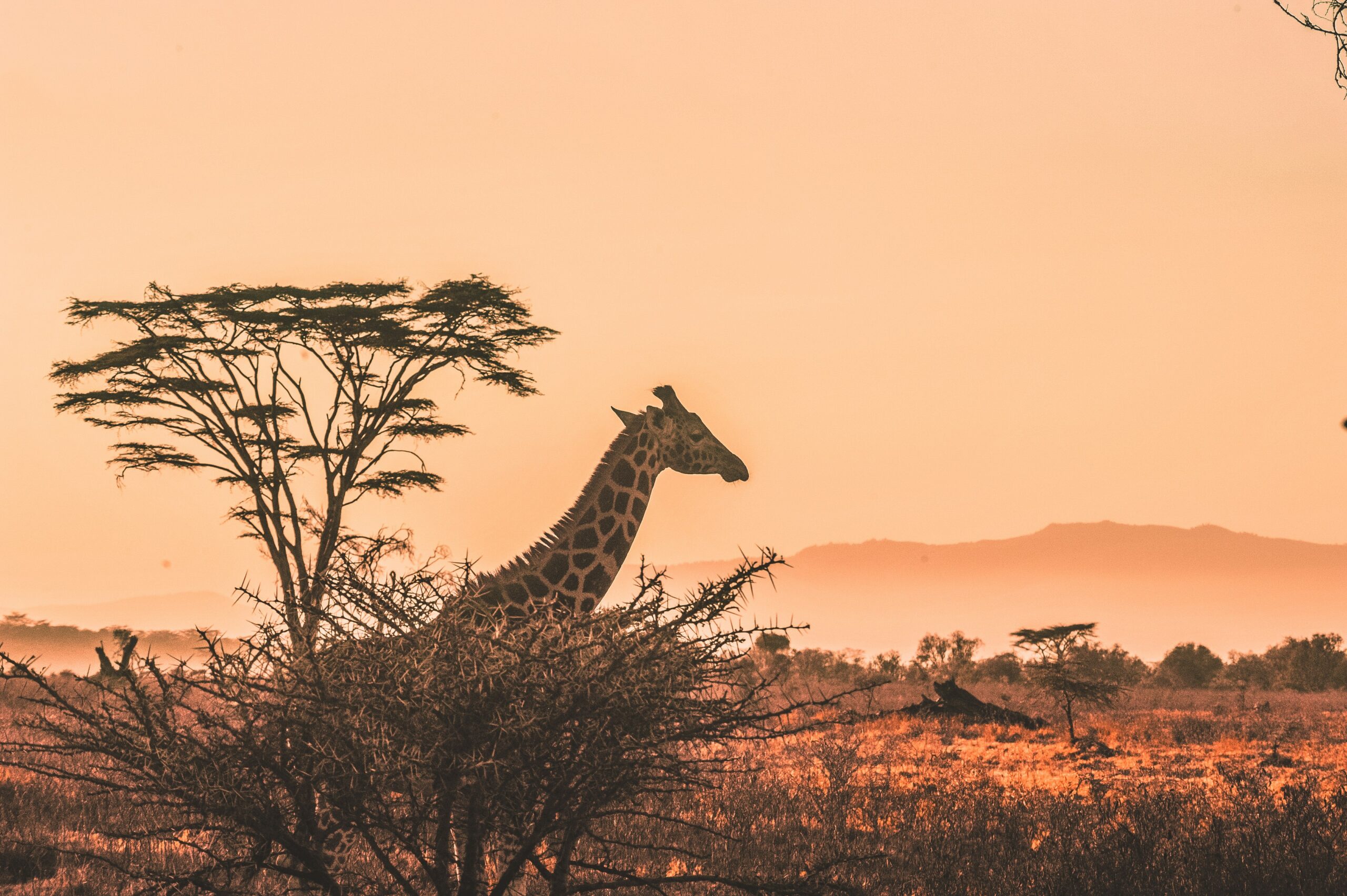
The Maasai Mara remains Kenya’s flagship, an extension of the Serengeti ecosystem across the Tanzanian border, and the stage each year for one of the most dramatic wildlife spectacles left on Earth, over a million wildebeest and hundreds of thousands of zebra crossing the crocodile filled Mara River as part of their endless pursuit of fresh grazing. But Kenya’s wildlife story runs well beyond the Mara. Amboseli offers, on a clear morning, the single most photographed wildlife backdrop in Africa, elephant herds moving across the plains beneath Kilimanjaro’s snow capped summit, even though the mountain itself sits just over the border in Tanzania. Samburu and Buffalo Springs, in the drier north, hold species found almost nowhere else, Grevy’s zebra, reticulated giraffe and the long necked gerenuk, animals adapted specifically to this harsher, more arid landscape.
What genuinely sets Kenyan wildlife apart, though, is the density and diversity packed into relatively small, accessible areas, and the sheer sophistication of how it’s now being managed. Kenya pioneered the private and community conservancy model that has since been copied across the region, land bordering national parks and reserves, often owned by Maasai or Samburu communities, leased to tourism operators who limit visitor numbers strictly in exchange for guaranteed lease payments that flow directly to the landowners. The Mara conservancies surrounding the national reserve now cover more land than the reserve itself, and they’ve become genuinely important to the ecosystem’s survival, offering wildlife corridors, lower visitor density and a share of tourism revenue that gives local Maasai communities a direct, tangible stake in keeping the land wild rather than converting it to farmland or settlement.
Community Tourism and Regeneration
This is really where Kenya’s story becomes most compelling. The conservancy model didn’t emerge from a single grand policy but from decades of painstaking negotiation between conservationists, tour operators and the communities who actually own the land, and it has become one of the most closely watched conservation experiments in Africa. Organisations like the Northern Rangelands Trust now support dozens of community conservancies across northern Kenya, covering millions of acres and directly involving hundreds of thousands of people, funding schools, healthcare and anti poaching efforts through tourism revenue and grazing management plans developed with, rather than imposed on, local communities.
Ol Pejeta Conservancy, home to the last two northern white rhinos on Earth, has become a genuine model for integrating rhino protection with community benefit, while the Il Ngwesi and Naibunga conservancies in Laikipia are entirely community owned and run, employment, tourism revenue and decision making authority sitting with the Maasai and Samburu families who live there rather than with outside operators. Along the coast, community led marine conservancies have taken on coral reef restoration and sustainable fishing practices in places like Kuruwitu and Diani, addressing decades of overfishing with locally enforced no take zones that have shown measurable recovery in fish stocks within just a few years.
What makes this approach genuinely regenerative rather than simply sustainable is the direction of travel. Wildlife numbers in and around well managed conservancies have stabilised or grown, degraded rangeland has been restored through community grazing plans, and a meaningful share of tourism revenue now reaches the households actually bearing the cost of living alongside elephant and lion. It isn’t uniform across the country, and plenty of challenges remain around land pressure, drought and balancing tourism income with community needs. But Kenya has done something few countries have managed at this scale, proving that conservation and community prosperity can be built as the same project rather than as a trade off, and that model, refined here over thirty years, has become something the rest of the continent is now learning from.


